How to buy antibodies for mass cytometry conjugation
So you've designed your mass cytometry panel and
realized that Standard Biotools (previously Fluidigm) doesn't offer conjugated
antibodies for several of your specific markers.
That's where the conjugation service comes in.
We can conjugate almost any antibody to any of the lanthanide metals.
We use the MaxPar kits from Standard Biotools and keep all of the metals
in stock so we can conjugate your antibodies whenever you need.
How we conjugate your antibodies
To help understand why we recommend different types and formulations of antibody it helps to understand how we conjugate your antibodies.
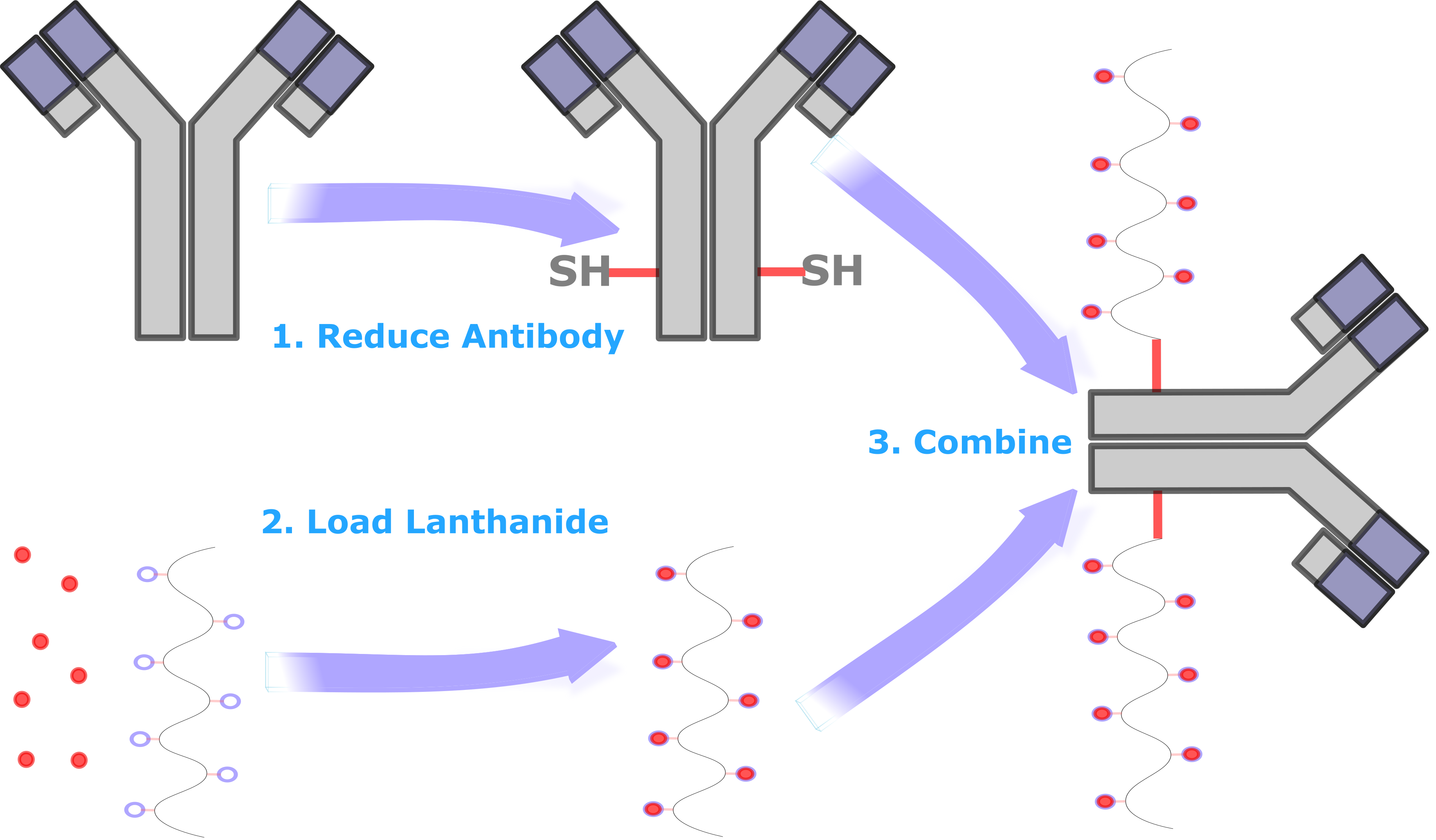
- The antibody is reduced to expose sulphide groups
- Specific lanthanides are loaded onto linker molecules.
- The linker is joined to the free sulphide groups
BSA-free antibodies, please!
BSA is commonly used as a carrier protein in antibody formulations.
- It helps stabilize the antibody making it last longer in the fridge.
- It's cheap and compatible with staining media
BUT BSA is a major problem when conjugating antibodies.
- BSA has >33 disulphide bridges
- IgG has between 3 and 6 disulphide bridges available for conjugation
- BSA will conjugate the linker-lanthanide molecule 10x more than IgG
- This results in very poor conjugation efficiencies
If BSA-free is unavailable...
- Unavailable
- Prohibitively expensive
Reagent Selection
PRE-CONJUGATED ANTIBODIES
Antibodies already conjugated to lanthanide metals are primarily available from Standard BioTools. They have an extensive catalogue of markers, especially if you are working in:
- Immunology
- ImmunoOncology
- Developmental Biology
The selection of antibodies incresases month by month so it's worth checking to see if your favourite antibodies have become available from Standard BioTools
Reagent Selection
CONJUGATING ANTIBODIES
If you're working in other fields you'll have to source some of your reagents from other sources (your usual antibody vendors will be fine). Purchased antibodies for conjugation they should be:
- Carrier-Free
- IgG
- Monoclonal (preferred)
- 100ug
We can conjugate these antibodies to any lanthanide for you.
Other Additives
Several different molecules are used as stabilizers in antibody formulations. Let's look at how they might afect your conjugations.
Glycerol
Glycerol is added as a cryopreservative to prevent antibodies freezing easily, so that they don't lose activity from a freeze-thaw. Glycerol under 20% has no deleterious effect on conjugations
Other Additives
Gelatin
Gelatin is added to antibodies as a stabilizing carrier protein
- Gelatin contains no disulphide bridges.
- It will not hinder the conjugation reaction.
- However, we quantify the conjugation process by measuring
- A280 absorbance (by NanoDrop). Gelatin will confuse this readout and not allow us to precisely quantify how much antibody we return to you.
- The Pierce antibody cleanup kit referred to earlier can remove gelatin from preparations
Other Additives
Trehalose
Trehalose is a cryoprotectant and antibody stabilizer
- Trehalose is a carbohydrate with no disulphide bridges.
- It will not hinder the conjugation reactions.
Other Additives
Azide or thimerosal
Thimerosal or Sodium Azide are added as preservatives/bacteriostats.
- They have no effect on mass cytometry conjugation reactions.
Formulations to look out for
Until recently, getting a carrier-free antibody formulation was relatively difficult. However, many companies are now selling antibodies formulated for mass cytoemtry conjugation reactions. Look for formualtions labelled:
- Mass Cytometry Ready
- CYTOF Ready
- Carrier Free
Monoclonal Preferred
Monoclonal antibodies are preferred. They are clonal so each molecule will conjugate and stain with the same efficiency.
This is only preference though!
We have had success conjugating polyclonal antibodies so if this is your only option then don't worry - they can and will work!
IgG Preferred
All conjugation protocols are optimized for IgG. Protein reduction can do odd things to IgM and IgA due to their multimeric structures but we (and others) have had success conjugating IgM so if it's your only option it's still worth a shot.
100ug Preferred
The conjugation protocols we use are formulated to use 100ug of antibody as input. We expect to return 60-80% of this to you as conjugated protein. This generally provides enough antibody for validation, testing and completing your project. We can conjugate 50ug of antibody but the efficiency is greatly reduced versus 100ug. We highly recommend providing 100ug if you can.
Supernatants or Ascites
If your antibody is only available cell-line supernatant or ascites all is not lost. You'll need to extract the antibody from media or ascites using a Protein A or G (there are many kits available to do this) and resuspend the antibody in carrier-buffer. After that we can conjugate as normal.